
ORCiD 0000-0003-3168-3628

(2026) What do parents want? Relevant content and formats for resources to address issues of racism, antiracism, and xenophobia with youth
with Deborah Rivas-Drake, Victoria Vezeldenos, Gabriela Livas Stein, Dawn P. Witherspoon, Tiffany Yip, Christia Spears Brown, Enrique Neblett
Abstract:
Diverse U.S. parents seek to engage in conversations about racism and immigration injustices with their children. To inform the design of a free resource hub and curriculum, we interviewed 62 parents of 3–17 year olds across 6 demographic categories (Asian/Asian American, Black, Latinx, Multiracial, Native American, White). We explored the question: “What content (substance and format) would be useful for parents in addressing issues of race, racism, and immigration with their children?” Analyses yielded multiple cross-cutting themes addressing both the substance and format of resources parents viewed as important for addressing these topics. Four content themes include: (a) Desire for Credible, Non-partisan Information; (b) Testimonials as Windows and Mirrors; (c) Age Appropriateness; and (d) Systems and Intersectionality. The two main format themes to emerge were: (a) Multiple Modalities and Sources and (b) Interactive and Ready-made. Implications for the development of ethnic-racial and antiracism socialization interventions and other resources are discussed.

(2026) Listening to teachers: Facilitating content and conditions for addressing issues of racism and xenophobia with youth in schools
with Deborah Rivas-Drake, Victoria Vezeldenos, Gabriela Livas Stein, Dawn P. Witherspoon, Tiffany Yip, Christia Spears Brown, Enrique Neblett
Abstract:
Teachers are uniquely positioned to promote racial and immigration justice in schools. This study draws on interviews with a U.S. educator sample (N = 26; 50% ethnoracially minoritized; 42.3% pre-K or elementary, 15.4% middle school, 34.6% high school) from a needs assessment for a public scholarship effort aimed at providing resources to advance anti-racism and anti-xenophobia. Combining a rigorous and accelerated data reduction (RADaR) method and reflexive thematic analysis, we developed 8 themes: 5 pertaining to substantive issues, 2 to format concerns, and 1 integrating both substance and format issues. Our expansive approach in the present study, including educators from early childhood through adolescence, allowed us to note both shared and unique needs for supporting race- and power-conscious ethnic-racial socialization, underscoring the importance of this process across developmental periods. These insights could help professional development providers and facilitators, program developers, and school leaders implement teacher-informed approaches to support teachers’ racial learning.
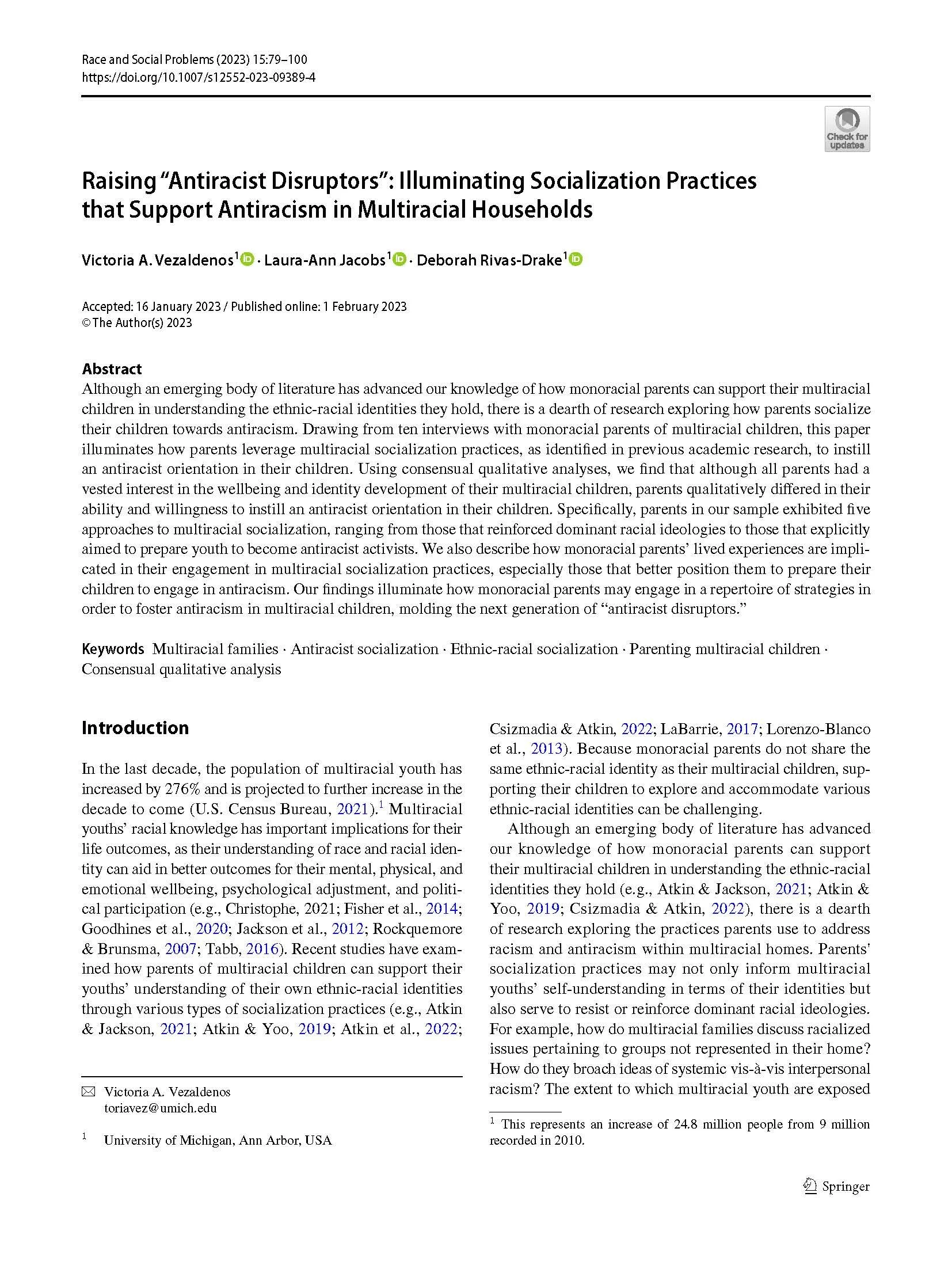
Vezaldenos VA, Jacobs LA, Rivas-Drake D. Raising "Antiracist Disruptors": Illuminating Socialization Practices that Support Antiracism in Multiracial Households. Race Soc Probl. 2023;15(1):79-100. doi: 10.1007/s12552-023-09389-4.
(2023) Raising "Antiracist Disruptors": Illuminating Socialization Practices that Support Antiracism in Multiracial Households
with Victoria Vezaldenos and Deborah Rivas-Drake
Abstract:
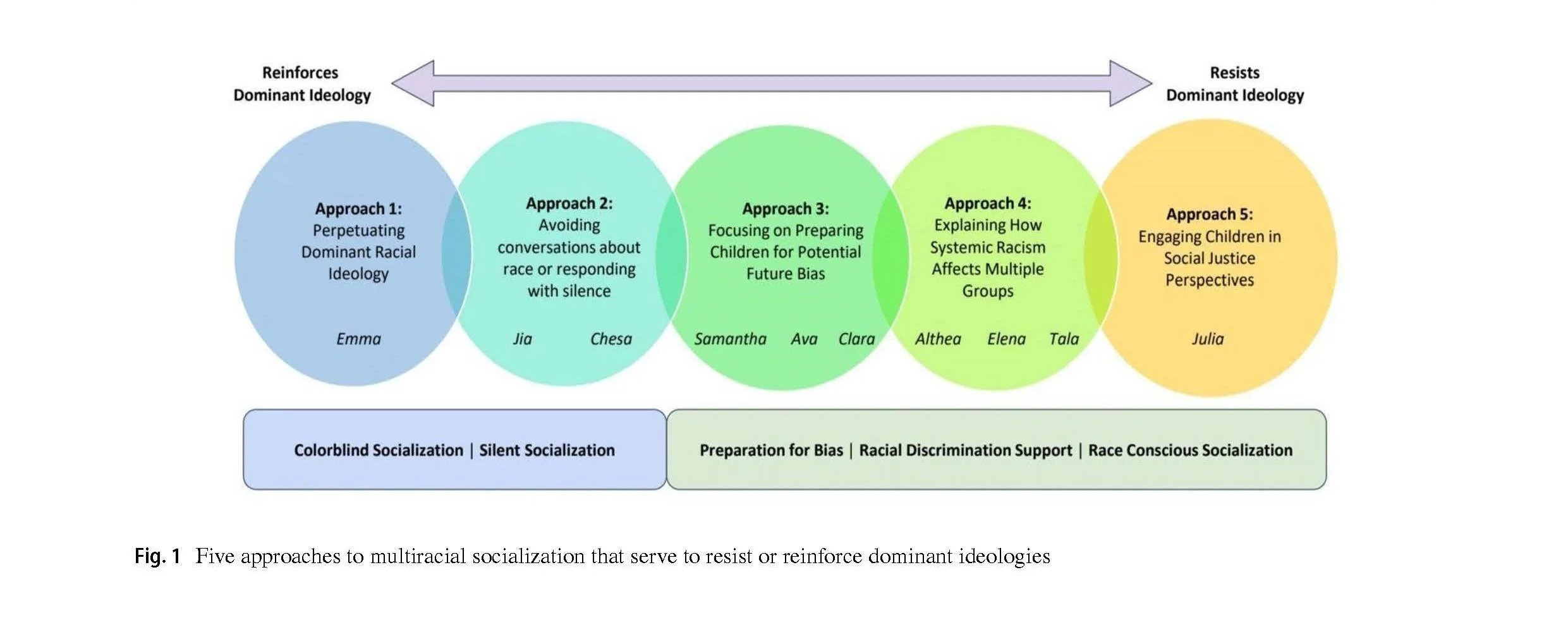
Although an emerging body of literature has advanced our knowledge of how monoracial parents can support their multiracial children in understanding the ethnic-racial identities they hold, there is a dearth of research exploring how parents socialize their children towards antiracism. Drawing from ten interviews with monoracial parents of multiracial children, this paper illuminates how parents leverage multiracial socialization practices, as identified in previous academic research, to instill an antiracist orientation in their children. Using consensual qualitative analyses, we find that although all parents had a vested interest in the wellbeing and identity development of their multiracial children, parents qualitatively differed in their ability and willingness to instill an antiracist orientation in their children. Specifically, parents in our sample exhibited five approaches to multiracial socialization, ranging from those that reinforced dominant racial ideologies to those that explicitly aimed to prepare youth to become antiracist activists. We also describe how monoracial parents' lived experiences are implicated in their engagement in multiracial socialization practices, especially those that better position them to prepare their children to engage in antiracism. Our findings illuminate how monoracial parents may engage in a repertoire of strategies in order to foster antiracism in multiracial children, molding the next generation of "antiracist disruptors."

Garcia, P., Jackson, A., Jacobs, L.A. (March 2020). “Centering the identities of Girls of Color in computational thinking programs.” Research on Equity & Sustained Participation in Engineering, Computing, & Technology (RESPECT). http://respect2020.stcbp.org/wp-content/uploads/2020/08/Research_5_RESPECT_2020_Garcia_Jackson_Jacobs.pdf
(2020) Centering the Identities of Girls of Color in Computational Thinking Programs
with Patricia Garcia and Ashley Jackson
Abstract:
Efforts to broaden participation in computing have revealed the need for a deeper theoretical and empirical understanding of how girls of color form computing identities. In this paper, we use the concept of identities-in-practice as an analytical frame to examine how girls of color engage in computational thinking practices. Our research investigates how the identities of girls of color can be leveraged as funds of knowledge in learning spaces and asks the following research question: How does centering the identities of girls of color impact their engagement with computational thinking practices? We provide a program overview of CompuGirls, describe our curricular design approach, and share results from pilot implementations of the program offered at public libraries in Michigan, Arizona, and California. Results from our pilot year demonstrate that integrating identity exploration into a computational thinking curriculum results in a mutually reinforcing relationship where girls of color experience reflective identity development while simultaneously increasing their understanding of computational thinking. We present our approach as a promising avenue for connecting computing knowledge and skills to girls’ identities and lived experiences. By focusing on the girls’ identities, the program re-imagines computational experiences by fostering interactions with computational thinking from a personal perspective. Ultimately, we argue that centering girls’ identities should be viewed as an integral part of the learning process and not tangential.